

In a world dominated by international communication and cross-border contracts, certified legal translation has become more than just a service—it is an essential necessity to ensure accuracy in transactions and the protection of rights. Choosing a certified legal translation office is the first step toward the success of any legal process, whether with government bodies, private entities, or international institutions.
This is where Al-Fahd Certified Translation Services stands out, offering extensive expertise and absolute precision in translating legal documents, giving clients confidence and peace of mind at every stage of their legal dealings.
Indeed, working with a certified legal translation office like Al-Fahd guarantees high-quality translation of contracts, court rulings, and official certificates, aligned with international standards and avoiding potentially costly legal errors. Moreover, with strict adherence to professional and ethical standards, Al-Fahd has become the ideal choice for those seeking accurate, fast, and reliable certified legal translation.
Table of Contents
- Introduction: Certified Legal Translation Office
- Overview of Certified Legal Translation
- The Importance of Choosing a Professional Company like Al-Fahd
- The Role of Certified Legal Translation in Contracts and International Transactions
- How Certified Translation Protects the Rights of Parties
- Core Challenges in Legal Translation
- Linguistic and legal differences between countries
- Terminological and stylistic complexities
- Absolute accuracy and error-free translation
- Requirements for a Certified Legal Translator
- Academic qualifications and practical experience
- Linguistic and analytical skills
- Certification and licensing
- Types of Documents Requiring Certified Legal Translation Office
- International contracts and agreements
- Court rulings and official certificates
- Government documents and educational certificates
- Countries and Entities Requiring Certified Legal Translation
- Major countries relying on certified legal translation
- Official bodies and international institutions
- Examples: embassies, courts, ministries
- The Procedure of Certified Legal Translation
- Document submission
- Translation review and certification
- Receiving the final documents
- Ethical Standards and Quality of Certified Legal Translation
- Professional confidentiality and data protection
- Accuracy and adherence to legal terminology
- Continuous quality updates at Al-Fahd
- Customer Testimonials for Al-Fahd Certified Translation Services
- Conclusion: Certified Legal Translation Office
- Summary of the importance of certified legal translation
- Invitation to trust Al-Fahd for guaranteed quality
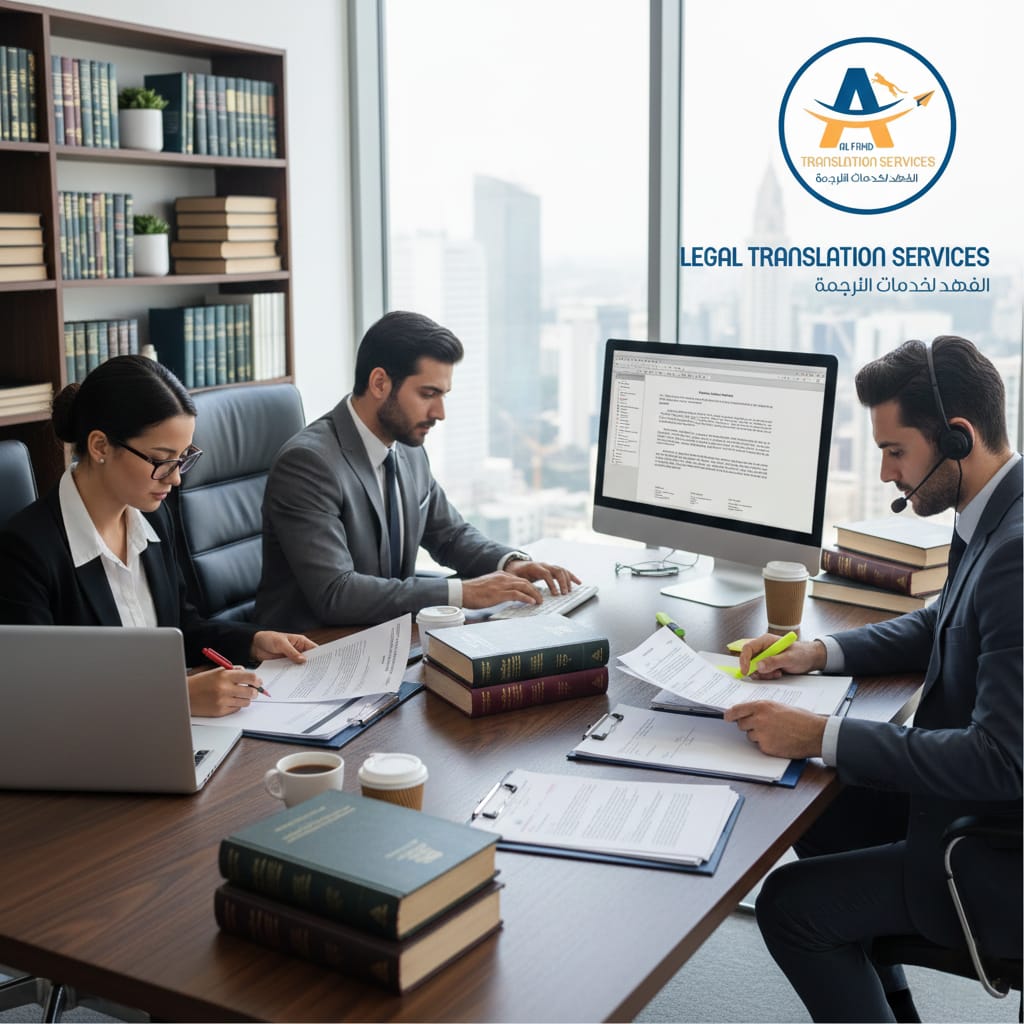
An Overview of Certified Legal Translation: Past and Present
Certified legal translation has evolved significantly over the centuries, influenced by changes in international trade, the development of judicial systems, and, most recently, the technological revolution. This evolutionary journey can be divided into two main phases:
1. The Past: Legal Translation as a Personal and Formal Process (Traditional Era)
In the past, translators conducted certified legal translation in a highly personal and centralized manner, primarily depending on their own trustworthiness as well as the authority of the bureaucracy.
A. Dependence on the “Sworn Translator”
- Centralization and Personalization: The legal translator was often a “sworn translator” (one who had taken an oath before a high judicial authority or court) or someone officially accredited by a government entity (e.g., Ministry of Justice or Foreign Affairs). Their personal status provided the legal validity of their translations.
- Manual Work: All work was done manually, whether handwritten or typed, which made the process time-consuming and labor-intensive when reviewing originals and copies.
- Limited Resources: Bilingual legal references were scarce, making the translator’s expertise and direct knowledge of both legal systems indispensable.
- Complex Certification: Certification often required multiple visits to a notary, the Ministry of Foreign Affairs, and then the relevant consulate or embassy (unless bilateral agreements existed), making the process slow and costly.
B. Linguistic and Methodological Nature
- Focus on Literal Accuracy: Emphasis was placed on verbatim translation, even if the result sounded awkward in the target language, as long as official terminology was preserved.
- Limited Specialization: Legal translators typically covered broad areas of law (contracts, personal status, litigation), while deep specialization (e.g., maritime law or intellectual property) was rare.
2. The Present: Legal Translation as a Global Technological Industry (Modern Era)
Today, certified legal translation has become a structured global industry, leveraging technology to enhance speed, accuracy, and consistency.
A. The Role of Technology and Support Tools (CAT Tools)
- Speed and Consistency: Translators now rely heavily on Computer-Assisted Translation (CAT) tools, which allow for translation memories and termbases. These tools ensure absolute consistency in complex legal terminology across thousands of documents and significantly reduce translation time.
- Handling Large Volumes (e-Discovery): In major litigation, advanced machine translation (MT) is used alongside human post-editing to process vast amounts of electronic documents efficiently.
- Digital Security: Sensitive legal documents are transmitted and stored on secure, encrypted platforms, adhering to global data protection protocols (e.g., GDPR).
B. Specialization and Professional Organization
- Deep Specialization: Translators now often specialize in complex fields of law, such as data protection law, mergers and acquisitions, or international arbitration.
- International Legal Framework: The Apostille Convention has become the standard for certifying documents among member countries, simplifying recognition and making the process faster and more efficient than traditional consular methods.
- Accreditation Bodies: Accreditation is no longer limited to ministries of justice; professional organizations and international translator associations now establish standards for quality and certification for legal translators.
C. The Future of Certification and Documentation
- Electronic Certification: Many countries are moving toward digital certification for legal translations, using reliable electronic signatures instead of physical stamps, which speeds up submission and receipt.
- Artificial Intelligence (AI): While AI cannot replace certified translators, it increasingly assists with preliminary review, term extraction, and draft enhancement, allowing translators to focus on legal accuracy and conceptual transfer rather than mere word-for-word translation.
In short, certified legal translation has evolved from a personal craft into a comprehensive global profession, where accuracy is ensured not only by the translator’s expertise but also by advanced technology and simplified international legal frameworks.
The Importance of Certified Legal Translation
Certified legal translation plays a pivotal role in international legal transactions, ensuring that legal texts are clear and accurately understood by all parties. For instance, a single error in an international contract can lead to serious legal disputes or financial losses.
Additionally, certified translations provide credibility to documents before courts, embassies, and government authorities. Using a globally recognized certified legal translation company, such as Al-Fahd, ensures compliance with official standards and acceptance of legal documents by all official entities.
Certified translation also facilitates communication between global companies and helps build trust between legal parties. It is not merely word-for-word translation but the precise transfer of legal meaning, reflecting obligations and rights accurately.
In short, certified legal translation is the first line of defense in protecting rights and ensuring proper legal dealings. This is why Al-Fahd Certified Legal Translation Office is the ideal choice for accurate and reliable translation of legal documents.
Core Challenges in Legal Translation
Despite its importance, certified legal translation faces significant challenges, making the use of a specialized translation office essential. Key challenges include:
- Linguistic and Legal Differences Across Countries: Each country has a unique legal system, meaning legal terms may differ in meaning depending on context. Certified translators must deeply understand both source and target languages, along with local and international laws.
- Terminological and Stylistic Complexity: The structure of contracts and legal rulings varies across countries. Translators must convey legal meaning accurately while maintaining official legal style. Terms like “Writ,” “Subpoena,” and “Estoppel” carry specific legal connotations that cannot be translated literally. Functional equivalents must be used in the target legal system.
- Absolute Accuracy Requirement: Even minor translation errors can have serious legal consequences, such as voiding contracts or challenging document validity. Leading companies like Al-Fahd employ multi-stage proofreading to ensure total accuracy.
- Handling Various Document Types: This includes international contracts, official certificates, court judgments, and government documents, each with unique formats and requirements.
- Ethical and Confidentiality Standards: Legal translation often involves sensitive documents, requiring complete confidentiality and strict adherence to accuracy and impartiality.
These challenges make it crucial to rely on Al-Fahd Certified Legal Translation Office, which offers extensive experience and specialized skills to ensure precise, error-free, and officially recognized legal translations.
Requirements for Certified Legal Translators
To be qualified to provide certified legal translations, a translator must have the following competencies:
- Academic Qualifications and Practical Experience: A university degree in translation or law, with several years of professional experience in legal translation, ensuring understanding of precise terminology, legal systems, and contracts.
- Linguistic and Analytical Skills: Ability to comprehend and accurately analyze complex legal texts, then render them in the target language while preserving legal meaning and official terminology.
- Official Accreditation and Licensing: Certification by relevant official bodies, ensuring translations are legally valid and accepted by courts, embassies, and ministries.
- Ethical and Professional Standards: Complete confidentiality, data protection, accuracy, and impartiality.
- Ability to Handle Various Legal Documents: Including contracts, official certificates, court rulings, and government documents.
Relying on a certified legal translation office like Al-Fahd guarantees that every translator possesses these qualifications, providing clients with peace of mind and confidence in translation quality.
Types of Documents Requiring Certified Legal Translation Office
Legal documents requiring precise certified translation include:
- International Contracts and Agreements: Partnership contracts, sales agreements, distribution agreements, and international employment contracts.
- Court Judgments and Official Certificates: Court rulings, legal memorandums of understanding, criminal records, and summons.
- Government Documents and Educational Certificates: Birth and marriage certificates, divorce documents, academic certificates, and professional experience certificates.
Therefore, using a certified translation company ensures all these documents are accurately translated in a formal style acceptable to legal and governmental authorities.
Countries and Entities Requiring Certified Legal Translation
Most foreign countries require certified legal translations for official documents, especially for government dealings. Key examples include:
- Saudi Arabia, UAE, Kuwait: Certified translation required for contracts and legal certificates.
- Europe (Germany, France, UK): Required for judicial and educational documents.
- USA and Canada: Certified translation required for contracts and official documents for legal or immigration purposes.
Entities requiring certified translation include:
- Embassies and consulates
- Courts and judicial bodies
- Ministries and government agencies
- Multinational companies
By choosing Al-Fahd Certified Legal Translation Office, clients ensure their documents are accepted by all these entities without delay or rejection.
Steps in the Certified Legal Translation Process
Certified legal translation follows precise steps to ensure quality:
- Document Submission: Clients provide original documents or certified copies to the office.
- Determining Translation Type: Identifying whether the translation is for official, judicial, or academic purposes.
- Initial Translation: The certified legal translator translates the texts with high accuracy.
- Proofreading and Review: A specialized team checks the translation against the original and ensures it is error-free.
- Final Certification: Document is stamped and certified by the translator or office.
- Delivery of Final Documents: Clients receive certified copies ready for official use.
This process guarantees every translated legal document is ready for official use without any issues.
Ethical Standards and Quality in Legal Translation
Al-Fahd adheres to strict ethical standards to ensure translation quality:
- Professional Confidentiality: Client data is protected and never shared externally.
- Accuracy and Legal Terminology Compliance: Correct legal terminology is used to avoid confusion.
- Continuous Quality Updates: Latest international standards are applied for superior quality.
These standards make Al-Fahd Certified Legal Translation Office a preferred choice for reliable certified legal translation services.
Client Testimonials for Al-Fahd
Al-Fahd has earned a strong reputation among clients for:
- Fast execution and high accuracy
- Professionalism and full confidentiality
- Ability to handle various legal documents
- Providing support for any legal translation inquiries
Furthermore, international client experiences confirm that choosing a certified legal translation office like Al-Fahd provides peace of mind and avoids potential legal issues.
To view customer experiences, please open the link:
https://g.page/r/CZIPVPlLKPzTEBM/review
Conclusion: The Pivotal Role of Certified Legal Translation
Ultimately, certified legal translation has become indispensable in the world of international business and law. Choosing a certified legal translation office like Al-Fahd ensures precise and reliable translation of all types of legal documents while fully adhering to ethical and professional standards.
Whether you require translation for international contracts, court rulings, or government documents, Al-Fahd provides the ideal solution, guaranteeing both fast turnaround and uncompromising quality. Don’t leave your legal documents to chance—trust the expertise of Al-Fahd Certified Translation Services to navigate all legal challenges with confidence and peace of mind.
Investing in certified legal translation services is an investment in legal security, accuracy, and success—exactly what Al-Fahd Certified Translation Office delivers with professionalism and credibility.
Contact Al-Fahd Translation Services
📞 Phone: 01111936688 – 01125102149
📧 Email: cairo1st@alfahdtranslationservices.com
📍 Address: 19 Mohandeseen Buildings, Nasr City – Nearby City Stars
No matter your inquiries, we are always at your service!
Al-Fahd Certified Translation Company – Certified translation for all languages, Certified Legal Translation
For more details about certified translation and how to choose the service that suits you with Al-Fahd Certified Translation Company.